
NOCO Genius 5 vs 10 (Comparison & Review)
Welcome to the Car Battery Nerd.
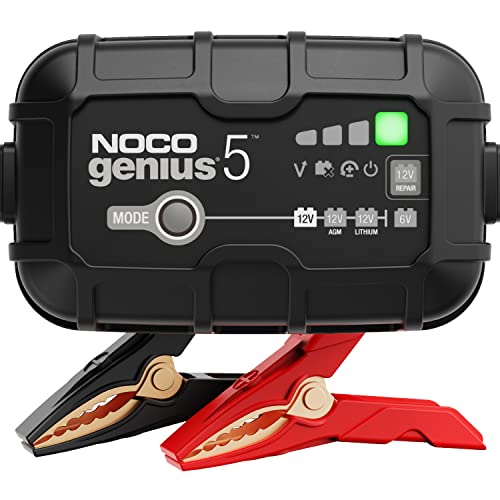
This is NOCO Genius 5 vs Genius 10.
If you’re reading this article, it’s a fair bet that you’ve decided that a NOCO Genius is the charger you want, and you just want to know which Genius model you need.
If so, good decision. They’re two of the best car battery chargers on the market, and they’re priced quite reasonably.
If not, then you’re probably at least considering this make and model.
In this article, we’ll explain very simply and very clearly how you can decide which model is the one you need.
We do so by simple bullet points showing the ways that these battery maintainers are the same, and the ways that they are different.
We’ll give you the confidence you need to make your decision.
If you’re in a big rush, you may check out the best place to buy the Genius 5 on Amazon, right here.
And the same for the Genius 10.

Comparing the NOCO Genius 5 and Genius 10 Chargers
We’ll start this contest with a simple head-to-head comparison of the two models.
This is the main specifications of each, as well as the functions offered.
You’ll see that the Genius 10 offers double the charging amps and hence double the power.
The Genius 10 also works with much larger batteries, up 230Ah, compared to a maximum of 120Ah for the Genius 5.
Here’s our comparison table.
| Category | Genius 5 | Genius 10 |
|---|---|---|
| Voltage: | 6V/12V | 6V/12V |
| Charging Amps: | 5A | 10A |
| Weight: | 1.59lb | 3.99lb |
| Dimensions: | 3.43″D x 4.61″W x 7.95″H | 4.48″D x 4.41″W x 9.1″H |
| Output Power: | 75W | 150W |
| Suitable For Car Battery Capacities: | Up to 120Ah | Up to 230Ah |
| 12V Repair Mode (reconditions batteries): | ✅ | ✅ |
| 12V Supply Mode (powers DC appliances, like ): | ❌ | ✅ |
| 12V Force Mode: | ✅ | ✅ |

What These Two Smart Battery Chargers Have In Common
Here are the good and bad things that are the same about both the Genius 5 and Genius 10.
‣ Same NOCO ability to deliver consistent, sustained power output levels
Both the 5A and 10A versions can deliver their claimed maximum amperage consistently over a long time. You can attribute that to NOCO’s use of high quality materials for both the internal components and the wiring, clamps, casing etc. As well as a sophisticated PCB to handle the electronic circuitry.
‣ Both are market leaders for temperature-adjustment
By that we mean, that both models have the same Genius (pun intended) ability to adjust to the ambient temperature. And, as we’ve used many dozens of chargers, in our time, we rate them as the market-leaders for how well they can change their charging cycle according to how hot or cold it is. Both models have a very smart integrated thermal sensor. But it’s not just having the sensor that is important, there are a few other car battery maintainers that have similar chips. The genius part is the way that their charging cycle responds – making sure that you still get a powerful enough charge, without going too hard and causing it to overheat. Some chargers we’ve tested will adjust too much, and slow the charging down to a snail’s pace.
‣ Very strong ability to keep batteries healthy
NOCO Genius chargers are good value considering their high quality. But there are quite a lot of low-cost chargers on the market that will do a decent job of charging your battery. What both the Genius 5 and 10 will offer beyond those other chargers is the ability to just charge your battery but keep it healthier for longer. That’s thanks to their reconditioning AKA desulfation mode, which uses bursts of high frequency pulses to remove lead sulfate buildup on your car battery’s plates (by the way, there are specialised battery reconditioners available). NOCO call it Repair Mode, and in our experience, it’s the best reconditioning mode in the world, even better than CTEK’s (also excellent) Recond Mode. Other cheaper chargers do offer similar modes, but they simply aren’t nearly as effective as the NOCO or CTEK chargers.
‣ Excellent clamp quality
We mentioned the clamps earlier, in our first point. But these clamps are worth mentioning as a point of their own; we’ll explain why: an automotive charger is only as good as its clamps. The unit itself can deliver as pure and powerful a 10 amp charge (for example), but if the clamps aren’t quite up to scratch, then it doesn’t matter how much charge it pumps, the power will never actually reach your vehicle battery. The clamps simple MUST be able to connect really well with your battery terminals, as much physical contact as possible, and really staying in that set position. So, then. The NOCO clamps are superb. You can feel their quality the second you pick them up. They give you great contact with battery terminals, for all kinds of batteries, and are really well made.
‣ Both are unsuitable for small batteries
Some chargers, like the CTEK MXS 5.0, for example, are suitable also for much smaller batteries. If you also have a scooter, and let’s say it has a 10Ah or 12Ah battery, you’d be able to use the CTEK charger to fill the battery. Both these Genius chargers, at 5 amps and 10 amps respectively, are too powerful for such a small battery.
‣ Both are relatively highly priced, compared to other maintainers of their size
We’ve mentioned a couple of times in this comparison review that these chargers are outstanding value for money, given their almost-unique strengths compared to other brands. But they are certainly more expensive than competitors of the same size.
The blue bullet points above listed our analysis from experience of the quality of both NOCO smart chargers.
Now, we’ll list the technical aspects that are the same for both:
- Both work with all kinds of 12V lead-acid batteries, lithium (LiFePO4) batteries, and 6V sealed lead-acid batteries
- Both come with a 72-inch AC cable, 80-inch DC cable
- Both have a specific AGM mode. If you have an AGM battery, you definitely want this (and you may want it in your battery tester as well).
- Both have NOCO’s (excellent) Force Mode, able to charge batteries that are deeply discharged down to near zero volts.
- Both work in extreme temperatures, from -4°F to 140°F
Now let’s check out what’s different about them.
The Differences Between the NOCO Genius 5 and Genius 10
Here’s what separates these two maintainers:
‣ 5A charging versus 10A charging
So, to be clear, the Genius 5 charges with 5 amps, and the Genius 10 offers a 10 amp charge.
How do you know what charging amps you need?
Well, the typical rule of thumb of automotive battery charging is that you use charging amps of around 10% of your battery’s capacity in Ah. So a 40Ah battery would ideally get approximately 4A charging, a 50Ah battery would best work with around 5A charge.
This is a rule of thumb, not a strict rule that you must follow. It applied more in the past, before smart chargers, when the unit could provide a dangerous overcharge. That’s not a problem with these NOCO maintainers, which have many protections to prevent that.
That said, the rule of thumb is still useful as an approximate guide.
‣ The Genius 10 works with 6V AGM
Both models work with all kinds of 12V lead-acid batteries, including normal sealed lead-acid, as well as AGM, enhanced flooded batteries (EFB), and lithium batteries.
And both work with 6V batteries that are normal sealed lead-acid (all kinds), and EFB. But only the Genius 10 works with 6V AGM batteries.
Do you need, or reckon you’ll ever need, to charge 6V AGM batteries? If so, get the Genius 10. If not, use some other criteria to make your decision.
‣ Genius 5 does not have 12V Supply Mode
The Genius 10 has a 12V supply mode, and the Genius 5 does not.
What is 12V Supply Mode. It basically provides a way to power some 12V DC devices, such as a tire inflator, oil changer or pump.
If this mode is something that you could make use of, then opt for the Genius 10.
You can also use it to maintain a power supply to your vehicle’s computer memory (often called the ECU or ECM) during a battery change. Depending on your car, removing the battery during the battery change process may wipe the computer settings, which may include the current driving mode, music playlists, GPS saved addresses, and suchlike.
Choosing Which NOCO Maintainer You Need
The top of this article had plenty of technical differences and discussion about that.
Let’s now give a simple way to decide the Genius 5 vs. 10 battle for you.
Choose the Genius 5 if:
You want the NOCO Genius excellent build quality, and high-power charging. And you’re attracted to it above other chargers for its unique advantages, such as the excellent Force Mode, and the Repair Mode (reconditioner, desulfator) as we mentioned in the above section.
[This sentence applies equally to the Genius 10 as well]
AND
You have a small to medium-sized car battery, let’s say 40-65Ah.
And you’re only going to be using it for overnight charging, you don’t think you’ll need particularly fast charging.
Choose the Genius 10 if:
You want the NOCO Genius excellent build quality, and high-power charging. And you’re attracted to it above other chargers for its unique advantages, such as the excellent Force Mode, and the Repair Mode (reconditioner, desulfator) as we mentioned in the above section.
[This sentence applies equally to the Genius 5 as well]
AND
You have a large-size automotive battery, let’s say 70Ah to 100Ah.
Or if you have a normal-sized battery but you reckon you will want to fast charge sometimes.
Or if you think you may get a larger car in future, and hence would need a larger charger for the bigger battery.
NOCO Genius 5 vs. Genius 10 Summary
Hope we were able to help with your decision.
As you read, these models share plenty of major advantages over almost the whole rest of the car battery chargers on the market.
NOCO are a century-old company, but they haven’t rested on their laurels. Other brand have risen and provided good products, but the NOCO Genius models are unmatched for their ability to recondition batteries, even better than CTEK. (FYI, they’re also the top maker of jump starters, as we detail in our NOCO GB40 vs GBX45 vs GB70 comparison and review).
Their sustained power delivery excels, and we’ve always been big fans of Force Mode, since we’ve experienced a few occasions where batteries couldn’t be charged because their voltage was too low. Force Mode is a great solution for that issue.
That’s all well and good, but you came to this page to decide between the 2 models, to compare the Genius 5 and Genius 10.
We finally recommended that you should choose the Genius 5 if you have a normal-to-medium-sized auto battery, perhaps around 40Ah to 65Ah, and you plan to use ot for overnight charging. And choose the Genius 10 if you have a medium-to-large sized battery, of around 70-100Ah. Or if you want faster charging.
You may also want to buy the Genius 10 model if you may ever need to charge 6V AGM batteries, or if you want to power some 12V DC devices, or to maintain your car’s ECU/ECM memory during a battery charge.
Did you make your decision?
This is the lowest cost seller of the Genius 5 on Amazon, right here.
And here’s the same for the Genius 10 model.
Good luck and enjoy!